Salzburg Highlights

Salzburg Highlights

LATEST IN SALZBURGOrchestra Concerts
Home . Sitemap . Jobs . Deutsch
Salzburg Highlights bietet Urlaub in Salzburg. Der Reiseanbieter informiert über Sehenswürdigkeiten, Ausflugsziele und kulturelle Veranstaltungen. Pauschalen und Angebote für Konzerte, Gastronomie, Schifffahrt und Hotels in Salzburg online verfügbar.

Theater/Play Venues

The Grosse Festspielhaus (Grand Festival Hall), the Haus für Mozart (House for Mozart) and the Felsenreitschule (Cliffside Riding Academy) along with the 200 meter distant Domplatz (Cathedral Square) and the Kollegienkirche (Church of Councils) make up the Festival area. In 1606/07 Archbishop Wolf Dietrich had stables built here that were expanded in 1662 to become a Winter Riding Academy. In the 19th Century the complex served as Cavalry barracks and was finally opened up to the Salzburg Festivals in a step-by-step process starting in 1925.

To the Guides of the Salzburg Festivals


Domplatz (Cathedral Square)

The Salzburg Cathedral is the largest early baroque church north of the Alps. The first church at this site was built in 774 by the Holy Virgil. In 1598 the Cathedral was destroyed by fire. Archbishop Wolf Dietrich commissioned the planning and construction of a new Cathedral. In 1614 construction on the new Cathedral began under the supervision of Archbishop Markus Sittikus. In 1628 the new Cathedral was consecrated by Archbishop Paris Lodron. The war destruction in 1944 was followed by re-construction in 1959. The Mariensaule (Column of the Holy Mary) at the “Domplatz” was completed in 1771 by Wolfgang and Johann Baptist Hagenauer. The figures at its base represent wisdom, the church, an angel, and the devil. Since 1920 this has been the setting for Hugo von Hofmannsthal’s “Jedermann” (Everyman) performances.
The spectator grandstand offers seating for 2,544 people. The mobile stage conceals a number of built-in trapdoors and hollows for the performers. In the case of inclement weather the “Jedermann” performances will be held in an alternate venue: the “Grosse Festspielhaus” (Grand Festival Hall).

Felsenreitschule (Cliffside Riding Academy)

The “Felsenreitschule” was built at the site where the rock formations were broken up to be used in the construction of the Cathedral in the first half of the 17th century.

Under the supervision of Archbishop Johann Ernst Thun and in accordance with the plans of the Baroque master-builder, Johann Bernhard Fischer von Erlach, the “Felsenreitschule” was carved out of the rocks of the “Moenchsberg” (Monks Mountain). Back at that time this “Summer riding academy” was host to animal hunts and riding exhibitions.

The audience was seated in the 96 arcades that were laid out one on top of the other on three tiers. In 1926 max Reinhard made a first attempt to utilize the “Felsenreitschule” as a venue for the performances of the Salzburg Festivals by staging Goldonis’ “Der Diener zweier Herren” (A Servant of Two Masters). It was also here, in the year1933, that Clemens Holzmeister erected the so called “Faust-Stadt”(Faust-City) , a set design that was counted among the most impressive of its time. Herbert von Karajan transformed the “Felsenreitschule” into an Opera stage for the first time in 1948 for the performance of Gluck’s “Orfeo ed Euridice”.

In the years 1969/70 a significant transformation took place - once again in accordance with the plans of Clemens Holzmeister. The stage with a width of 40 meters received an “understage” with a depth of 4 meters. The cantilever spectator tribune was renewed along with the underlying “scenery storage depot”. A light-proof, extendable, rain tarpaulin with noise dampening, rain-catcher netting protects the stage. This “roof” can be opened up. The “Felsenreitschule” accommodates 1,437 spectators (1,412 seats and standing room for 25).

Grosse Universitaetsaula (The Grand, University Auditorium)

Construction History
The Grand Auditorium of the University of Salzburg, founded in 1622 by the Benedictines was already one of the most significant centers for the nurturing of the spiritually baroque “Theaterkultur” (Theater Culture) in the 17th and 18th Century. It was erected as the “Aula Maior” in the University complex in 1631 in accordance with the model of master-builder Santino Salari and it took 24 years to be completed. Still today, the paintings of the “Secrets of the Rosary” from the years 1636/37 (by Adrian Blomaert and Zacharias Miller, among others) call witness to its second, sacral utilization, as a Congregational hall. After its consecration in the year 1654 by Archbishop Paris Lodron, the founder of the University of Salzburg, a permanent Theater was integrated in 1660. In 1782 the Theater operations closed down.

After many renovations and building alterations (the latest one: 2003 to 2005, Architects George Huber and Karl Meinhart for the new foyer; the interior in accordance with plans by Architect Frank Fonatsch; The Federal Property Association as the property developer along with the generous financial support of the Salzburg patrons of the arts: Donald and Jeanne Kahn, the Federal government, and the Province of Salzburg) it was ceremoniously reopened on the 27th of January, 2005 on Mozart’s 249th Birthday.

The Grand University Auditorium is located in the Old University building in the heart of Salzburg’s Old Town in the “Furtwaengler Park which is located at the Max-Reinhadt-Square in the Festival area.

Mozart-Original-Venue
Wolfgang Amadeus Mozart, the genius loci of Salzburg, appeared on stage here as a dancing “Page” in 1761 in the school drama “Sigismundus Hungaria Rex” (Music by: J.E.Eberlin, Text by: P.M.Wimmer). Mozart was just 5 years old at the time.

His youth opera “Apollo et Hyacinthus” (KV 38) had its premiere here on the 13th of May, 1767; Mozart himself played the Harpsichord. It is with this Opera, performed by the Mozarteum University of Salzburg, that the Grand University Auditorium was ceremoniously reopened on the 27th of January 2005.

The interior now shines in a radiant white, just like it did back in Mozart’s lifetime. Optimal acoustics, comfortable graduated seating, artist’s dressing rooms, an unobstructed entryway, and high-tech, state-of-the-art equipment make it a Concert and Theater Hall that meets and exceeds today’s standards and demands.

Technical Data
Area: approx. 660 square meters
Stage Size: From 61 to 90 square meters
Seating Capacity: Depending on stage size, anywhere from 504 to 624;
2 optically integrated wheelchair spaces through the removal of 10 theater seats
A central control room, Sound system, Lighting system, Video projector (10,000 ANSI-Lumen); Ticket office, Buffet, and Orchestra furniture

Grosses Festspielhaus ( Grand Festival Hall)

Construction and Dedication
The Grand Festival Hall was built in accordance with the plans of the Architect, Clemens Holzmeister. Construction began in the year 1956 with the excavation of around 55,000 cubic meters of rock formation from the face of the “Moenchsberg” (Monks Mountain) in order to create room for the huge stage area. With its overall width of 100 meters (including side stages) it counts among the largest in the world. The Grand Festival Hall was dedicated on the 26th of July 1960 with the performance of Richard Strauss’ “Rosenkavalier” (The Knight of the Rose) under the direction of Herbert von Karajan.

Interior Features
The spectator area has a almost square layout with the length of each side measuring approx. 35 Meters; the Auditorium encompasses 2,179 seats. As you enter off of the “Hofstallgasse”, five bronze doors grant you access. The Facade carries an inscription that was penned by Thomas Michels OSB: SACRA CAMENAE DOMUS / CONCITIS CARMINE PATET / QUO NOS ATTONITOS / NUMEN AD AURAS FERAT. (This holy house of musings is here for those fascinated by art, carry aloft oh divine powers, we the inflamed). Clemens Holzmeister placed great value on the use of local materials in the “outfitting” process: the steel re-inforced concrete pillars were dressed up with rocks that were hewn from the face of the “Moenchsberg” (Monks Mountain), the floor of the foyer consists of “Adneter” Marble. The room is illuminated by narrow angle lighting fixtures that were installed in the sloped ceiling and by back-lighting fixtures integrated behind the wall panels made of “Murano” glass. It also has its own access-way leading to the center of the “Old Town” parking garage by means of an escalator. The “Fördererlounge” (Patrons Lounge) located on the first floor (the furnishings were donated by Donald and Jeanne Kahn) has served the Salzburg Festivals as a reception hall for its Patrons and Sponsors since 1995.

“Art” in the “Grossen Festspielhaus” (Grand Festival Hall)
Two of Wander Bertoni’s sculptures, crafted in Carrara marble, typify the “Music” and the “Theater”. The New York Painter and sculptor, Robert Longo created four large crosses for this site in 1993 with the theme “Dreams with the Wrong Solutions”. They were purchased by the Austrian art patron and collector Karlheinz Essl and then put on loan to the Salzburg Festivals. The four free-standing, cross-shaped, large-scale, paintings are retained in the colors blue, red, gold, and black.
Robert Longo gave the following explanation for his color scheme: Blue for “Pressure on the Sky”, Red “Fire Prayers”, Gold “Lamentations in Public”, and Black “Songs of Resignation”. In the adjoining Intermission Hall the original character of the Lord Archbishops’ Royal stables was preserved. The new floor is made of green Ophite and inlaid with Equine mosaics created by Kurt Fischer. The steel relief on the wall portrays the “Homage of Anton von Weber” and was created by the Austrian sculptor, Rudolf Hoflehner. Through the Fischer-von-Erlach Portal you have an unobstructed view of the “Pferdeschwemme” (Horse pond) and the “Schüttkasten” (granary) which was acquired in 1987.

Technical Data
Stage width: 100 Meters
Stage depth: 25 Meters
Portal width: 30 Meters
Portal Heigth: 9 Meters

Five Hub Podiums 18 x 3 Meters each; max. speed of travel: 0.25 / sec. ; load capacity: 20 Tons each Hydraulic stage machinery (Dual system from ABB).

Schnürboden (Fly loft): 155 Traction assemblies with a load capacity of 500 kg. each. A third of these are hydraulically driven and can be electronically steered.

Lighting: 825 adjustable circuits with a minimum output of 5000 Watts each; a digital light control console; 2000 Spotlights are kept on hand in the equipment storage area.

Electro acoustics: sound mixing console with 16 input jacks and 16 output jacks plus 4 auxiliary output jacks; hook-ups for loudspeakers and microphones throughout the stage and spectator areas.

Haus für Mozart

Building History
The Haus for Mozart was formerly known as the “Kleine Festspielhaus” (Small Festival Hall) and has undergone many alterations since it first opened in 1925. In 1937 the spectator area was rotated 180 degrees which made it necessary to build an addition onto the main stage. In order to make the necessary room the Governor, Franz Rehrl, had his place of birth, the Toscaninihof torn down. In 1939 Benno von Arent redesigned the Festival Hall and replaced the wood panelling with a gold decorated, plaster ceiling. The spectator hall had a length of approx. 55 Meters. The unfavorable viewing and acoustic conditions necessitated another building alteration in 1962/63. The Salzburg Architects, Hans Hofmann and Erich Engels gave the Hall its appearance that it then kept until the 31st of August 2004.

Das Haus für Mozart (Formerly known as the Small Festival Hall)
All 22 of the Operas that Wolfgang Amadeus Mozart composed, starting with his early musical comedies and musical theatre fragments up to and including his world acclaimed Masterpieces, were performed in the year 2006 during the Salzburg Festivals: our gift in commemoration of the 250th birthday of Salzburg’s “favorite son”. The schedule of events for the “Year of Mozart” presented a great challenge, both artistically as well as organizationally. It not only meant engaging the best musical conductors, directors, and vocalists but also to clear up the question: What can be played where?

For many years the Salzburg Festivals have pursued the idea of creating a “Haus fuer Mozart” (House of Mozart) that would do justice in all respects for the Stage works of the Composer: with optimal acoustics and ideal visibility from every seat. Here you should be able to hear even the softest of Pianissimo-Nuances, to see it on the actors’ faces, to be able to follow their expressions. Along with a necessary intimacy, the room must also provide ample seating because Mozart’s music has many friends……

What appeared to be “the square of a circle” was made possible by the Architectural Team of Holzbauer and Valentiny: The former “Kleines Festspielhaus” (Small Festival Hall) was transformed into the “Haus fuer Mozart” in three constructional phases starting in September of 2003 and now meets all the afore-mentioned standards.

The Auditorium
The auditorium of the “Kleine Festspielhaus” was widened, shortened, and lowered. Two new tiers that reach up to the stage on both sides of the hall were added. By doing so the beautiful effect has been achieved that not the bare walls but people in a festive mood surround the stage on three sides. In the future, the “Haus fuer Mozart” will accommodate up to 1,580 people. There is seating for 1,495 and standing room for 85.

The Foyer Area
The Foyer area has also been altered substantially in contrast to the “Kleines Festspielhaus” of the past. High windows that span a number of stories allow a wonderful view from the main Foyer onto the cityscape. By the same token, the brightly lit interior of the Theater casts its light outside at night. The main Foyer is primarily characterized by a gold gilded “Lamellenwand” (A wall with wooden slats) 17 meters high. Through its openings you can view the head of Mozart created out of Swarovski crystals. A terrace located on the front of the hall was never accessible to the public since its construction in 1924. With the new construction it has now become a part of the “Intermission Foyer”. The underlying arcade was glassed-in and now makes it possible to open up the Auditorium from two sides instead of just one, like it has been previously. It also allows you to step out of the “Festspielhaus” into the magnificent urban landscape.

The SalzburgKulisse ( Salzburg Backdrop)
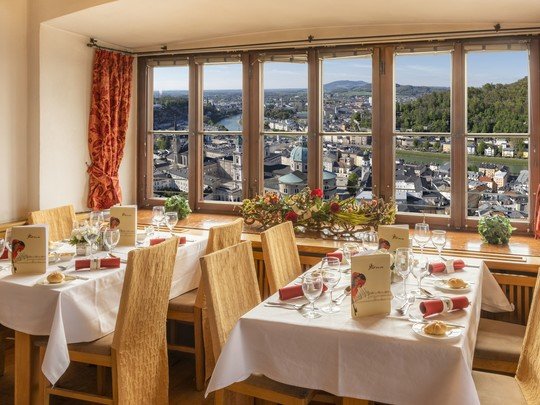
The “SalzburgKulisse“ (Salzburg Backdrop), the new Festival lounge on the roof, is becoming quite an attraction: Just its name alone is an indication of the magnificent view that awaits you as look upon the Old Town and into the Salzach River Valley. The interior walls of the lounge are wainscoted with Pear tree wood and the tapestries in the alcoves stem from Anton Kolig, a contemporary of Anton Faistauer.

The Faistauer – Foyer
The Faistauer-Foyer has become a jewel in this new “House”: The famous frescoes that adorn this room were created by the Salzburg Painter Anton Faistauer in 1926. They were removed during the Nazi invasion and some of them were wantonly destroyed. It was in the year 1956 that they could finally be refitted. They were restored back to their original condition for the Dedication of the “Haus fuer Mozart”. Moreover, the room itself was architecturally restored to its original, historical, state./p>

The Exterior Façade
The exterior façade has retained Holzmeister’s “Ensemble”, from the years of 1924/37, in its original proportions. The optical impression of the façade is determined by the representative hall exits that lead onto the terrace and were designed by the sculptor Josef Zenzmaier: He created large Bronze reliefs that were installed above the portals and portray scenes from Mozart’s “Le nozze di Figaro”, “Don Giovanni, and “The Magic Flute”. The Stone masks of Jakob Adlhart are now well visible in front of the main entrance of the “Haus” underneath the new, far-overhanging, gold leafed, concrete roof. Coarsely spattered concrete surfaces contrast with fine gold leaf throughout the whole house, thereby creating an aesthetic tension.

Toscaninihof (Toscanini Courtyard)
From the backstage area a huge iron door opens up onto the Toscaninihof, Attached to the outside wall, on the right and left-hand sides of the door, are six Concrete reliefs: “Maskenhaltende Genien” (Geniuses holding masks). They were knocked down in1938 but were reconstructed in 1979 by their creator, Jakob Adlhart. An organ was installed above the door on the outside and was played during inclement weather performances of “Jedermann”, prior to the construction of the Grand Festival Hall.

Kollegienkirche (Church of Councils)

The Kollegienkirche is also known as the University Church and was originally intended to be used for the University’s worship services. The Dedication of the church dates back to 1707. It was built by the most significant Church construction engineer of the city, Johann Bernhard Fischer von Erlach, and its construction lasted more than 70 years. This church was used as an architectural model for the construction of many late baroque churches in central Europe and today it also serves as a venue for many of the performances of the Salzburg Festivals.

Landestheater (Regional Theater)

The Salzburg “Landestheater” began its history as a building decorated with opulent rococo ornamentations. It was dedicated on the 1st of October 1893 with the performance of Mozart’s Opera “La Clemenza di Tito”. In 1938/39 the face of the building was altered. The ramp and the decorative embellishments had fallen victim to the renovation process, and a much needed main foyer and a so called revolving stage were added. A second renovation process, which took place in 1977/78, brought about additional improvements of the stage equipment and a modern air-conditioning system was installed. The spectator hall encompasses 697 seats and is used for Theatrical as well as Operatic performances.

Mozarteum

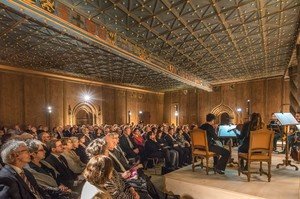
The Mozarteum was built between 1910 and 1914 in accordance with the blueprints of Munich architect Richard Berndl. The building, stylistically designed with an art nouveau influence, fits perfectly into the historical Salzburg cityscape. The monumental concert hall wing that encompasses an auditorium (Grand Hall) with a seating capacity of 807 is accessed through the Entrance Hall with its Bronze sculpture of “Mozart als Musagetè”. This hall is best suited for concerts with a small or medium sized orchestration.

Perner-Insel (Perner Island), Hallein

Salt was processed in the large old industrial hall of this historically registered area until 1989. Through the cultural initiative of the “szene Salzburg” a part of this facility was converted into a venue site that is used on a regular basis by the Salzburg Festivals. The conversion was completed in 1992 and was followed in 1998 by the addition of new, more generous seating as well as an Intermission Foyer. The venue site consists of a room with variable seating for up to 800 visitors. The performance and audience area in the former saline purification hall can be structured in accordance with the scenic concept of the Production that is currently being staged. In order to achieve ideal speech comprehensibility during the performances the room acoustics can be modified accordingly by means of variable wall coverings and ceiling reflectors. The stage equipment is mobile and can be integrated and coordinated as required by a particular “event”. This is also true of the Lighting and Electro-acoustics. The technical installations conform to the standards of the Festival Halls.

Schloss Leopoldskron (Leopoldskron Palace)

Schloss Leopoldskron was built in the years 1736 to 1744 to be used as the family seat of the Lord Archbishop Firmian. After his death, his heart was entombed in the Palace chapel. Laktanz, who was the Nephew of the Archbishop, an art connoisseur, and one of the first promoters of Mozart, resided in Leopoldskron palace for the subsequent forty years. With the start of the 19th Century there was a frequent change of ownership. Among the owners was Ludwig I of Bavaria and the banker, Carl Spaengler. In 1918 Max Reinhardt purchased Schloss Leopoldskron and imbued it with new life. In 1938 Leopoldskron was seized and used as a summer residence and guest house by the German Reich. Since 1947 it is owned by the Salzburg seminary which hosts conventions with political, economical, legal, social, cultural, and scientific agendas that are of global interest.
Schloss Leopoldskron was acquired by Max Reinhardt just prior to the founding of the Festivals, and through him became a creative and artistic Salon of the Festivals – a place of free and inspired encounters and discussions. Starting this summer Schloss Leopoldskron will become an event location for the series “Dichter zu Gast” (The Poet as our Guest) and consequently will opened up again in cooperation with the Festivals for the first time since Reinhardts Emigration.


Salzburg Festspielhaus Salzburg Festspielhaus Salzburg Festspielhaus Salzburg Mozarteum